Hogar
buscar
más | consejos
IMDb > City Lights (1931)
City Lights
Enlaces
Principales Enlaces
trailers and videosreparto y equipo completostrivialidadesofficial sitesfrases célebres
Revisión
información principalinformación combinadareparto y equipo completoscréditos de compañíastv schedule
Premios y críticas
comentarios de los usuarioscríticas externascríticas de grupos de usuariosawardsCalificacionesparents guiderecomendacionesforo
Argumento y citas
argumentoplot synopsispalabras clave del argumentosinopsis Amazon.comfrases célebres
Cosas divertidas
trivialidadespifiastemas musicalescréditos extravagantesotras versionesenlaces entre películaspreguntas frecuentes
Otro tipo de información
enlaces a productostaquilla/negociofechas de estrenolugares de rodajeespecificaciones técnicasLaserdiscDVDlecturas relacionadasNoticiero
Material promocional
frases comerciales trailers and videos carteles y enlaces photo gallery
Enlaces externos
enlaces a cinesofficial sitesmisceláneosfotografíassound clipsvideo clips

Fotos (ver todos los 37 | slideshow) Videos
City Lights (1931) -- AFI's 10 Top 10 - The 10 Greatest Films in 10 Classic Genres

Revisión

Calificación de los usuarios:
MOVIEmeter: ?
No change in popularity this week. See rank & trends on IMDbPro.
Director:
Charles Chaplin
Guionista:
Charles Chaplin (writer)
más
Contact:
View company contact information for City Lights on IMDbPro.
Fecha de Lanzamiento:
6 febrero 1931 (USA) más
Género:
Comedia | Drama | Romance más
Plot:
The Tramp struggles to help a blind flower girl he has fallen in love with. full summary | add synopsis
Plot Keywords:
más
Premios:
1 win más
Comentarios de los usuarios:
True Blind Love más

Reparto

  (Reparto completo)
Virginia Cherrill ... A Blind Girl
Florence Lee ... The Blind Girl's Grandmother
Harry Myers ... An Eccentric Millionaire
Al Ernest Garcia ... The Eccentric Millionaire's Butler (as Allan Garcia)
Hank Mann ... A Prizefighter

Charles Chaplin ... A Tramp (as Charlie Chaplin)
más
Create a character page for: ?

Más detalles

También conocida como:
City Lights: A Comedy Romance in Pantomime (USA) (copyright title)
Luces de la ciudad (Argentina) (Spain) [es]
más
Duración:
87 min
País:
USA
Relación de Aspecto:
1.20 : 1 más
Sonido:
Silent | Mono (musical score)
Clasificación:
France:U | Portugal:M/6 (DVD rating) | Spain:T | West Germany:12 (1951) | Germany:6 (re-rating: 1997) | USA:G (1972) | USA:Passed (National Board of Review) | South Korea:Todo | Argentina:Atp | Australia:G | Chile:TE | Denmark:A (2003) | Norway:7 | Sweden:Btl | UK:U

Cosas divertidas

Trivialidades:
At the beginning of the film, a town official and a woman dedicating the statue can be heard uttering nondescript words by way of a kazoo. These sounds are the very first "words" Chaplin ever spoke on film, as it is his voice you are hearing through the reed instrument. más
Errores:
Continuidad: When saving the man's life, and trying to climb out of the water, the position of the Tramp's hat is inconsistent. más
Citas:
The Tramp: Be careful how you're driving.
Eccentric Millionaire: Am I driving?
más
Conexiones de Película:
Apareció en The Pervert's Guide to Cinema (2006) más

preguntas frecuentes

Why is it called "City Lights"?
Is this movie based on a novel?
A Note Regarding Spoilers
más
31 out of 43 people found the following comment useful:-
True Blind Love, 15 February 2003
Author: lugonian de Kissimmee, Florida

CITY LIGHTS (United Artists, 1931), written, directed and starring Charlie Chaplin (1889-l977), is a silent comedy-drama released at the height of the sound era. Distributing a movie in the silent film tradition at the time when silents were considered a fad, Chaplin gambled with this production, and made it pay off. Although Chaplin hails THE GOLD RUSH (1925) as the one movie he would most want to be remembered, CITY LIGHTS nearly dims out his GOLD RUSH and at the same time, practically places his other silent masterpiece, THE CIRCUS (1928) to oblivion. CITY LIGHTS, along with his aforementioned features, has stood the test of time, balancing perfectly a mixture of comedy and drama, but in Chaplin's case, pathos.

CITY LIGHTS, subtitled, "A comedy romance in pantomime," begins in the early morning where the mayor is dedicating the unveiling of a statue to the citizens of the city. After the unveiling, the crowd finds a little tramp (Charlie Chaplin) sleeping on the lap of one of the figures. As he tries to climb down, he encounters one problem after another. This opening scene alone is pricelessy. With such a funny opening, it would seem impossible to top that. But Chaplin does with several more comedic insertions blended into the plot.

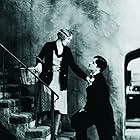
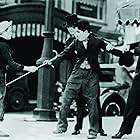
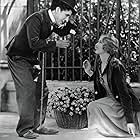
The theme to CITY LIGHTS is remembered mainly about a tramp's love for a blind girl. However, there is a subplot, involving the tramp's involvement with a millionaire drunk, which, by far, takes up more screen time than the sentimental love story involving the blind girl. These two segments actually set the pattern to the story. First segment, which takes place in the afternoon, finds Charlie walking down the street, examining a nude statue in a shop, being annoyed by some newsboys making fun of his tattered clothing, and encountering a beautiful blonde girl (Virginia Cherrill) selling flowers. After she drops one of her flowers, Charlie notices her feeling about the sidewalk for it, thus, realizing she is blind. Smitten by her beauty, he picks up the flower and pays her for it. Shortly afterwards, the slamming of a door of a limousine is heard, with the girl believing the kind gentleman, Charlie, to be a millionaire. Second segment, which takes place later that night, finds Charlie encountering a drunk (Harry Myers) who is trying to commit suicide by drowning himself. Just as Charlie is about to save him, he in turn falls into the river. The drunk, in gratitde for saving his life, takes Charlie under his wing and has him accompany him for a night on the town at various night clubs. By morning, the millionaire becomes sober and fails to recognize or remember Charlie. Because of this, he orders his butler to escort this stranger out of his mansion. This running gag with the millionaire drunk by night and sober by day and failing to recognize Charlie as his friendly companion might play itself as quite repetitive at times, and is, but Chaplin manages to breathe new life and funnier routines with his encounters with the drunk during their all night binges and partying. As for Charlie, by day, he looks after the blind girl, worries about her when she is not at her usual corner selling flowers. Finding out that the girl is ill and that her grandmother (Florence Lee), is behind with her rent money and threatened with eviction, Charlie offers his help by obtaining and losing various jobs to provide for them, ranging from streetcleaning to fighting in a boxing match, which turns out to be fixed. Reading in a newspaper about a doctor in Europe who might be able to restore sight for the blind, Charlie gives the girl @1,000 for an operation, the money offered to him by the drunken millionaire. Charlie later finds himself accused of robbing the millionaire, now sober, and following his arrest, serves some jail time. The fadeout, CITY LIGHT's most famous scene, is the most poignant ever achieved by Chaplin, and is not to be missed.

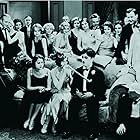
Featured in the supporting cast are Henry Bergman, Allan Garcia, Albert Austin, and Hank Mann. While much has been discussed about Chaplin's performance, his co-star, Virginia Cherrill, as the blind girl (no name given), should not go without mention. Even though her future film career consisted of forgettable programmers, and at one time being one of the future wives of film actor, Cary Grant, her performance is excellent by all means, in spite of rumors of her being difficult to handle during production. Although it's been said that future film star Jean Harlow (1911-1937) appears as an unbilled extra in the night club sequence, she is visible in a surviving still photograph, but no such scene seems to appear in the finished product. Chances are that since this movie was reportedly in production for almost two years, the night club sequences with Harlow seated in the background was either refilmed differently later on or cut from the final print.

Unlike THE GOLD RUSH, CITY LIGHTS had limited showings in revival houses in later years, and was never allowed to be distributed to television. I was first introduced to CITY LIGHTS around 1979 when it played in a popular revival house in New York City called The Regency Theater which was formerly located on Broadway and 67th Street. The one memorable thing about this event is the roars of laughter from its theater packed audience, and I mean theater packed. There was one man, probably a big fan reliving his childhood memories, whose laughter almost drowned out the underscoring of the film. It became obvious that he was having more fun watching this movie than anyone else. Maybe watching this movie in a crowded theater is one way to truly appreciate and experience the feel of silent film comedy, and to think back as to how the audience reacted in same to CITY LIGHTS back in 1931.

After Chaplin's death in December of 1977, CITY LIGHTS, along with his other silent features, were not only resurrected for a new generation to endure, but became readily available on video cassette by the time of Chaplin's 100th birthday, 1989. In later years, CITY LIGHTS was frequently revived on various cable channels, ranging from Turner Network Television (TNT) in the early 1990s, American Movie Classics up to 2001, and also on Turner Classic Movies. The complete musical soundtrack that accompanies CITY LIGHTS happens to be the original score composed to perfection by Chaplin himself. Aside from specific tunes used as themes for certain characters, the use of quackling noises in place of spoken dialogue in the opening segment shows the genius and creativity of Chaplin's work. On the whole, a movie to be seen more than once to fully appreciate what has become recognized as Charlie Chaplin's masterpiece.

Much has been written and said about CITY LIGHTS over the years. To learn more about the making, difficulties and long term preparations to CITY LIGHTS, either watch Kevin Blownlow's 1980 documentary, HOLLYWOOD: A Celebration of the American Silent Film, as narrated by James Mason, or other Brownlow documentaries dedicated entirely to Chaplin's career, which includes not only outtakes to CITY LIGHTS, but scenes involving Virginia Cherrill's temporary replacement, Georgia Hale, Chaplin's co-star in THE GOLD RUSH.

Was the above comment useful to you?
más

Foros

Discutir película con otros usuarios en Foro de IMDb para City Lights (1931)
Recent Posts (updated daily)User
Is the ending the best in film history? laffalott1
how is this movie not in TOP 10 premier46
Your Top ten favorite silent films Brawlski
What is the best joke in the movie? nirvanasaneurysm
Really Disappointed (Spoilers) michaelgrilo
Good film for a film club? Losseolisia
más

Recomendaciones

Si disfrutó este título, nuestra base de datos también recomienda:
- - - - -
Gone with the Wind Giant Modern Times Sullivan's Travels Big Fish
IMDb Calificación de los usuarios:
Mostrar más recomendaciones

Enlaces Relacionados

Reparto y Personal Completos Créditos de la compañía Críticas externas
Las 250 películas principales de IMDb IMDb Comedia section IMDb USA section
Add this title to MyMovies

You may report errors and omissions on this page to the IMDb database managers. They will be examined and if approved will be included in a future update. Clicking the 'Update' button will take you through a step-by-step process.