IMDb >
Notorious (1946)
Watch It
Adquirir en Amazon
Rent it at
blockbuster.com
Discutir en los foros More at IMDb Pro Add to My Movies Update Data
blockbuster.com
BETA
Discutir en los foros More at IMDb Pro Add to My Movies Update Data
Enlaces
Principales Enlaces
trailers and videosreparto y equipo completostrivialidadesofficial sitesfrases célebresRevisión
información principalinformación combinadareparto y equipo completoscréditos de compañíastv schedulePremios y críticas
comentarios de los usuarioscríticas externascríticas de grupos de usuariosawardsCalificacionesparents guiderecomendacionesforoArgumento y citas
argumentoplot synopsispalabras clave del argumentosinopsis Amazon.comfrases célebresCosas divertidas
trivialidadespifiastemas musicalescréditos extravagantesotras versionesenlaces entre películaspreguntas frecuentesOtro tipo de información
enlaces a productostaquilla/negociofechas de estrenolugares de rodajeespecificaciones técnicasLaserdiscDVDlecturas relacionadasNoticieroMaterial promocional
frases comerciales trailers and videos carteles y enlaces photo galleryEnlaces externos
enlaces a cinesofficial sitesmisceláneosfotografíassound clipsvideo clipsNotorious (1946) Más información en IMDbPro »
| Fotos (ver todos los 53 | slideshow) | Videos |
Revisión
Calificación de los usuarios:
Fecha de Lanzamiento:
6 septiembre 1946 (USA) másFrase comercial:
Notorious woman of affairs... Adventurous man of the world! másPlot:
A woman is asked to spy on a group of Nazi friends in South America. How far will she have to go to ingratiate herself with them? full summary | add synopsisPremios:
Nominated for 2 Oscars. Another 1 win & 1 nomination másComentarios de los usuarios:
Cheeseballs and champagne? Good grief! . . . másReparto
(Reparto completo)| Cary Grant | ... | T.R. Devlin | |
| Ingrid Bergman | ... | Alicia Huberman | |
| Claude Rains | ... | Alexander Sebastian | |
| Louis Calhern | ... | Captain Paul Prescott | |
| Leopoldine Konstantin | ... | Madame Anna Sebastian (as Madame Konstantin) | |
| Reinhold Schünzel | ... | Dr. Anderson (as Reinhold Schunzel) | |
| Moroni Olsen | ... | Walter Beardsley | |
| Ivan Triesault | ... | Eric Mathis | |
| Alex Minotis | ... | Joseph - Sebastian's Butler | |
| Wally Brown | ... | Mr. Hopkins | |
| Charles Mendl | ... | Commodore (as Sir Charles Mendl) | |
| Ricardo Costa | ... | Dr. Julio Barbosa | |
| Eberhard Krumschmidt | ... | Emil Hupka | |
| Fay Baker | ... | Ethel |
Más detalles
También conocida como:
Alfred Hitchcock's Notorious (UK) (complete title) (USA) (complete title)Tuyo es mi corazón (Argentina) (Venezuela) [es]
Encadenados (Spain) [es]
más
Parents Guide:
Add content advisory for parentsDuración:
101 minPaís:
USAColor:
Negro y BlancoRelación de Aspecto:
1.37 : 1 másSonido:
Mono (RCA Sound System)Clasificación:
Spain:18 | Iceland:L | UK:U (2008) | Norway:16 (1947) | Argentina:13 | Australia:M | Chile:14 | Finland:S | Germany:16 | Peru:14 | South Korea:15 (DVD rating) | Sweden:15 | UK:U | USA:Approved (PCA #11261)Cosas divertidas
Trivialidades:
The set used in this film for the interior of the house of Alex Sebastian (Claude Rains) can also be seen in the RKO production The Locket (1946) as the house of Mrs. Willis (Katherine Emery). This is especially noticeable in scenes filmed in the part of the set representing the second floor corridor. másErrores:
Continuidad: When Devlin and Alicia go to find Sebastian riding horses, when viewed from the front Alicia is nearest to the rails. When viewed from behind their positions are reversed and Alicia's horse has changed from chestnut to dapple gray. másCitas:
[first lines][Title card]: Miami, Florida, Three-Twenty P.M., April the Twenty-Fourth, Nineteen Hundred and Forty-Six...
[reporters and photographers converse amongst themselves outside the courtroom]
Judge: Is there any legal reason why sentence should not be pronounced?
District Attorney: No, your honor.
John Huberman: Yes, I have something to say. You can put me away, but you can't put away what's going to happen to you, and to this whole country next time. Next time we are going...
Defense Counsel: [whispering] I wouldn't say any more. We'll need that for the appeal.
más
preguntas frecuentes
To whom or what does the title "Notorious" refer?Is "Notorious" based on a novel?
What was in the wine bottles down in the wine cellar?
más
más
Foros
Discutir película con otros usuarios en Foro de IMDb para Notorious (1946) másRecomendaciones
Si disfrutó este título, nuestra base de datos también recomienda:
Mostrar más recomendaciones
|
|
|
|
|
| North by Northwest | Giant | L'accompagnatrice | City of Shoulders and Noses | The Man Who Knew Too Much |
|
IMDb Calificación de los usuarios:
|
IMDb Calificación de los usuarios:
|
IMDb Calificación de los usuarios:
|
IMDb Calificación de los usuarios:
|
IMDb Calificación de los usuarios:
|
Enlaces Relacionados
| Reparto y Personal Completos | Créditos de la compañía | Críticas externas |
| Las 250 películas principales de IMDb | IMDb Cine Negro section | IMDb USA section |
| Add this title to MyMovies |


"Notorious" is, of Hitchcock's "earlier" films, certainly the most durable and endlessly fascinating. Not, God knows, for its "brilliant" shots -- including the famous tracking shot from the foyer ceiling down to the key in Ingrid Bergman's hand.
But for the frank eroticism Hitchcock establishes from the opening party sequence on, and Bergman's breathtakingly uninhibited playing against her "virginal" type.
"Notorious" is riddled with bad, jerky rear-projection sequences. The first is Bergman's drunken drive along the Florida highway before the policeman stops her.
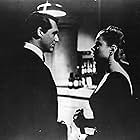
Then, every sequence where she and Cary Grant meet in the park in Rio. Sitting on that bench while the entire world "jerks" behind them.
Pitiful.
Do we care? Hell, no.
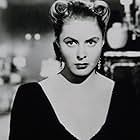
Ingrid Bergman was never so starkly sensual and frank on screen, as she is as "Alicia." And Cary Grant, as agent Devlin, was perfectly directed to play cold and largely unresponsive to Bergman's unrestrained and ultimately heartbreaking heat.
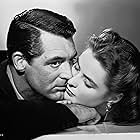
Grant is given subtle moments early on, to show his falling in love with Bergman. The brief glance he gives her as she leans across his lap in the plane descending into Rio, before Hitchcock quickly fades it out, is almost pornographic (for the era).
Their repartee is so fraught with sexual tension and mutual challenge as to be unparalleled in cinema up till that time -- and perhaps even since.
Bergman, so powerful an actress, is utterly vulnerable and natural in the early sequences -- emerging from her father's trial with her usual Bergmanesque stoicism, only to instantly become surprisingly, drunkenly, girlish and accessible and dangerous in the next sequence -- brushing windblown hair from her lips as she drives -- viciously fighting off Devlin when she realizes Devlin's an agent -- awakening to a hangover so realistic you can almost smell her breath steaming off the screen -- finally agreeing, out of patriotism, to help the "cause." The range of Bergman's performance, from drunken party girl desperate to escape her background, to duplicitous double-agent portraying "Madame" Sebastian in elegant surroundings, to helplessly, hopelessly lovesick Alicia finally in love with an unresponsive American agent (Grant) -- to an imprisoned woman dying of poisoning -- Bergman is simply brilliant.
She was never more sensually presented on screen.
Nor was Cary Grant. One does not expect emotional displays or outbursts from a government agent.
Grant's / Devlin's professional reluctance to admit, much less act on, his feelings for Bergman's Alicia is evident from frame one. His self-control as an actor and as a man was never better realized. At any moment, he could sexually assault Alicia -- whether out of rage or love is never clear, until the final, tender, moments of the film.
By the time Alicia and Devlin reach the infamous two-plus minutes on-off kissing scene in Alicia's Rio apartment, viewers of both sexes are watering at the mouth, wanting them to devour each other.
That they don't adds another layer of suspense to what ultimately becomes almost unbearable tension after Alicia weds Sebastian and moves in with him, his mother, and the other Nazis.
This is an amazingly daring film in terms of female sexuality, for its day or ours. Hitchcock asks us, as he asks Devlin, to sympathize with -- and love -- a woman who not only sleeps around just as men do, but who is willing to sleep around under false pretenses for the good of her adopted country. If that's a stretch for audiences now, consider what it was for audiences in the late 40s.
Is there another "heroine" in cinema history who blatantly sleeps with a man she despises in order to win the love (and successfully) of another man whom she adores?
Name one.
Not "Mata Hari," who, no matter that she was played by Garbo, had anywhere near the emotional/political/moral complexity of Alicia.
We still have to contend with those cheeseball rear-projection sequences. But Bergman and Grant play them so beautifully that the shoddy rear-screen technological primitivism is immediately forgiven.
And the secondary casting is so flawless that, in "Notorious'" final sequence, as Claude Rains is called back into the mansion and walks up those steps to his inevitable death, and the door closes while Bergman and Grant escape to a new life, our feelings are a mixture of triumph and pity.
Truly, one of Hitchcock's most complex, sexually challenging, political, adult, ambiguous and disturbing films.
Forget the cheeseball rear-projections, please.
"Notorious" is several glasses -- perhaps too many -- of vintage cinematic champagne.
Good grief!