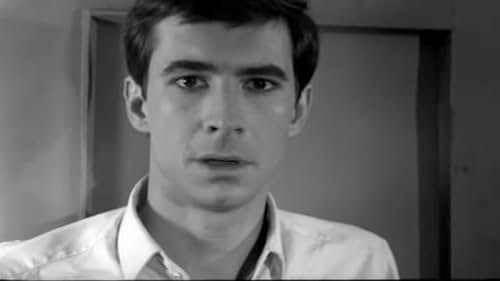
The story of The Trial is the story of displacement. The protagonist in the film Josef K, (played by Anthony Perkins), is seemingly from another world. His morality, conduct and philosophy contrast so sharply from the nightmare around him, that one wonders if he was transported to another universe while sleeping. As a result, Josef K has no survival skills in his environment and his adherence to a personal morale code that is totally alien to the world he lives in, consummates his destruction.
Josef K literally awakes in the first scene, to a nightmare that he cannot understand, because his own sense of justice refuses to let him understand it. This is Josef K's downfall. There are survivors in the world painted by this film, grim survivors to be sure, but survivors none the less. Josef K is not one of them.
Josef K, in the context that surrounds him in this film, is dysfunctional. He has neither the character nor the experience to survive in his world. He seems oblivious to the lunacy of his environment and strives for something so completely alien, that one wonders where and how he even conceived of his morale code, given the world he lives in.
This of course, leads to terrific drama and an odd tension for the viewer throughout the entire film. That tension springs from the dichotomy of the film, Josef K's idealism vs. the cruel reality all around him. Perhaps more specifically the tension arises from Josef K's struggle for logic and reason in a world gone haywire with paranoia and corruption.
One of the minor but important strengths of this film is the encapsulation of its theme within the 2-minute anecdote that starts the picture. This prologue uses stark drawings on a wheel to transition from scene to scene and is both a riddle and a parable. It is accompanied by a sinister cello and a deep, cold narration by Orson Welles. The anecdote in the prologue is a tale of a man who 'seeks admittance to the law'. The riddle that is laid before him ends in death and with the realization that the man wasted his life, seeking a universal truth, to a very personal question.
Much later in the film, the character of the Advocate tries to retell the chilling prologue to Josef K. Josef however, dismisses the fairy-tale immediately. Refusing to hear its lesson and how it applies to his predicament. The advocate rightly notes, from the prologue: 'it has been observed that the man came to the law of his own free will'. What I believe Orson Welles is telling us, in this scene, is he personally believes Josef K's character to be guilty. Josef is not guilty of a crime to be sure, but he is guilty in his conscience. Josef's wretched self-righteousness and guilt-complex is ugly, even within the context of all the injustice, corruption and abuse that surround him.
Josef is weak, stubborn and oblivious and I believe Orson tells us subtly, that perhaps he deserves to die. What is also left unsaid by the Advocate is the man in the prologue willingly submitted himself to the lunacy that became his death. The man felt it better to live chained to an ideal, that to roam free in an unjust world. If there is a crime Josef K is guilty of, then that is likely it.
I have never read the novel, but I believe Josef K, is a much more tragic figure in Kafka's eyes. In the eyes of Orson Welles - it's apparent to me that Orson Welles considers Josef K to be neither tragic nor overly heroic.
While it may contrast strikingly with Kafka's intention, I think Welles tries to illustrate somewhat that Josef K, is not a complete victim. While Josef's surroundings are nightmarish beyond belief, Josef never adapts to them. He never learns how to survive or worse, refuses to learn how to survive. He judges his world but he hardly ever truly interacts with it and he immediately becomes distracted whenever he feels someone has transgressed his moral view of things.
While the actions of Josef K are noble and we sympathize with his plight, you feel little remorse for his eventual death, because Josef quite simply just does not belong. Like the creature at the end of metamorphosis, an innocent thing, is perhaps best left to die, because it is alien to its environment.
Like all good work, that interpretation of mine is open to a lot of debate. Which is another great feature of this film, it provokes a reaction and that reaction can help you understand more about yourself and your current surroundings.
I think this is strong work. Orson Welles finds ways to delight your eyes on screen. Some of the performances like Romy Schneider's performance as the mistress of the Advocate are seductive and chilling.
It is interesting that women in this film are perverted, contorted and shallow. The perversion of society in Josef K's world is so pervasive that his own 16-year-old cousin cannot even visit him, without suspicion from his co-workers. Even sex and passion in this world is twisted into secrecy, innuendo and fear. The only true female survivors in this film are women who willingly cast themselves as supplicants to men of power and intrigue. While this message may affront those who are sensitive, it adds another element to the nightmare that makes this film so strong.
The film has a similar parallel to the Bicycle Thief in my opinion. The protagonist is sympathetic but is surrounded by injustice and cruelty that shreds his very existence. In both films, no amount of effort on the protagonist's behalf will solve his dilemma. Both characters struggle to come to terms with their tragic plight. Like Antonio, Josef K's quest is futile and his only salvation is acceptance. Unlike Antonio however, Josef K never truly transforms, he will not sink to the same level as the world around him. This is why we feel so sorry for Antonio at the end of the Bicycle Thief but see the Trial's ending as more inevitable than tragic.
It is sometimes hard to feel sorry for a martyr who wears his thorny crown so smugly. This is where the protagonist of Josef and Antonio (Bicycle Thief) depart. Josef willingly becomes a self-righteous martyr, while Antonio chooses life, even at the expense of his dignity.
The logic of this film is the logic of a dream and a nightmare. The Trial is a moral nightmare - a world where the only options for survival are: lies, hypocrisy and servitude. A sacrifice, Josef K, refuses to make and so his door closes, forever.